Do you know how Nestlé got Japan to drink coffee?
In 1975, they couldn't. Japan was a tea country. Always had been. Sales stayed flat no matter what they tried.
So they hired a French psychoanalyst, Clotaire Rapaille, to find out why.
His answer was strange. Japanese adults had no childhood memory of coffee. No emotional anchor. You can't sell someone a product their younger self never knew existed.
So Nestlé stopped selling coffee.
They made coffee-flavoured candy for children instead. Sweets, aimed at kids.
A generation later, those kids were adults, and they drank coffee. Today Japan is one of the largest coffee markets on earth.
Familiarity comes before trust, and trust comes before the sale. You don't get to skip to the end.
This is exactly where mainstream brands fail with Muslim consumers. Not because the product is wrong. Because the brand has never shown up.
Why showing up now matters more than founders realize
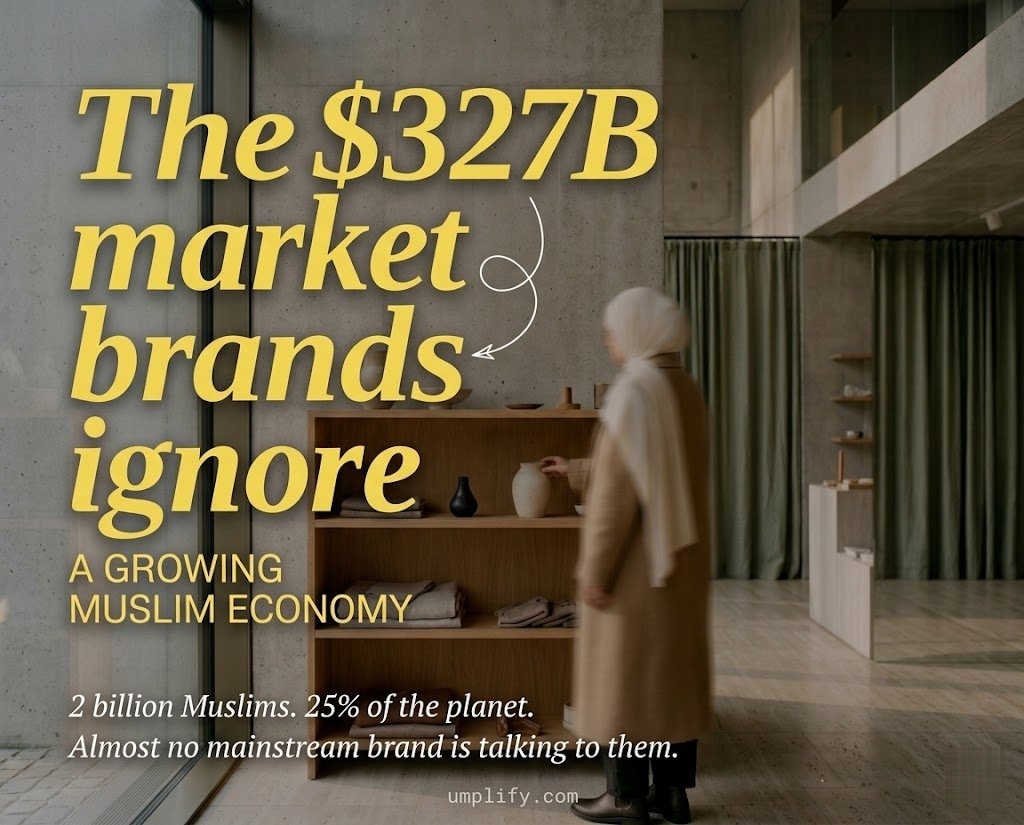
Two billion Muslims. Over 25% of the planet. Projected to hit 2.2 billion by 2030.
North America alone is a $186 billion market. Globally, Muslim consumers spent $2.43 trillion across six everyday sectors in 2023.
But the size isn't even the most interesting part.
This audience is young. Most of their household formation, peak earning years, and category loyalty are still ahead of them. Whoever shows up first in skincare, supplements, snacks, apparel, and home goods gets to define the default brand for the next decade.
Right now almost nobody is showing up.
The brands that move now don't fight for share. They build the category from scratch, inside a market that doesn't yet have a default name.
So why don't more founders start?
Because they picture halal audits, a new product line, a separate "Muslim strategy", a translated landing page. The whole thing looks expensive and complicated. For an audience they don't fully understand.
Wrong frame.
Here's the honest test. Look at your product. Does it contain anything explicitly haram? Pork-derived gelatin, non-halal animal fats, certain additives?
If the answer is no, you're already halal-compatible. Right now. With the product you already sell.
That covers most cosmetics, most supplements, most apparel, most snacks, most home goods.
The audience is already there. They already shop in your category. They're just not shopping with you, because you've never once spoken to them.
The few brands that try usually overcorrect
This is where it gets expensive.
Take Nike's "You Can't Stop Us" campaign. It showed a Muslim skateboarder in a niqab morphing into a short-haired LGBTQ figure, with the line "if we don't fit the sport, we'll change the sport." Muslim viewers understood the message in a second. They weren't the point of the ad. They were the setup.
Or take the brand that runs one Ramadan campaign every April. Eleven months in its normal look. Then for thirty days, the feed suddenly looks like the inside of a mosque, and the Muslim consumer feels like they're being taken for a ride.
Same mistake underneath both. Treating Muslim consumers as a seasonal line item instead of customers.
They notice. They always notice.
The Visibility Check (run it today)
Three steps. None of them touch your product.
1. The haram check (30 seconds)
Look at your ingredients or your spec sheet. Anything explicitly haram? Pork-derived gelatin, non-halal animal fats, certain emulsifiers? If not, you're already in the market. Stop overthinking it.
2. The visibility audit (1 hour)
Open your last twenty Instagram posts and your homepage. Count how many times a Muslim customer would catch a signal that says "this brand sees me." Not a hijab dropped into one Ramadan post. A real, recurring presence. Faces, names, contexts, language.
Be honest. The number is almost always zero.
That zero is the whole problem. It's also the whole opportunity.
3. The first rep (this week)
Pick one product you already sell. The one that needs zero changes. Brief one Muslim creator to film a single piece of content showing it inside their real life, their morning, their family, their routine.
Not a campaign. One test. You're not entering a new market. You're letting a market that already exists know that you exist too. Once that first piece proves itself, that's when scaling to multiple creators and paid media starts to make sense, not before.
Back to the coffee
Nestlé didn't argue adults into drinking coffee. They made it familiar first, then let the sale happen on its own.
You have it easier. You don't need to build a memory from scratch. The product already works. The buyers are already there.
The only thing missing is whether they ever see themselves when they look at your brand.
Knowing the size of the market is one thing. But most brands that try to enter it still trip on the very first piece of content, because they reach for the laziest move available: drop a hijabi into the existing ad and wait for sales.
In a related piece, I break down why that move almost never works, and what to do instead.